
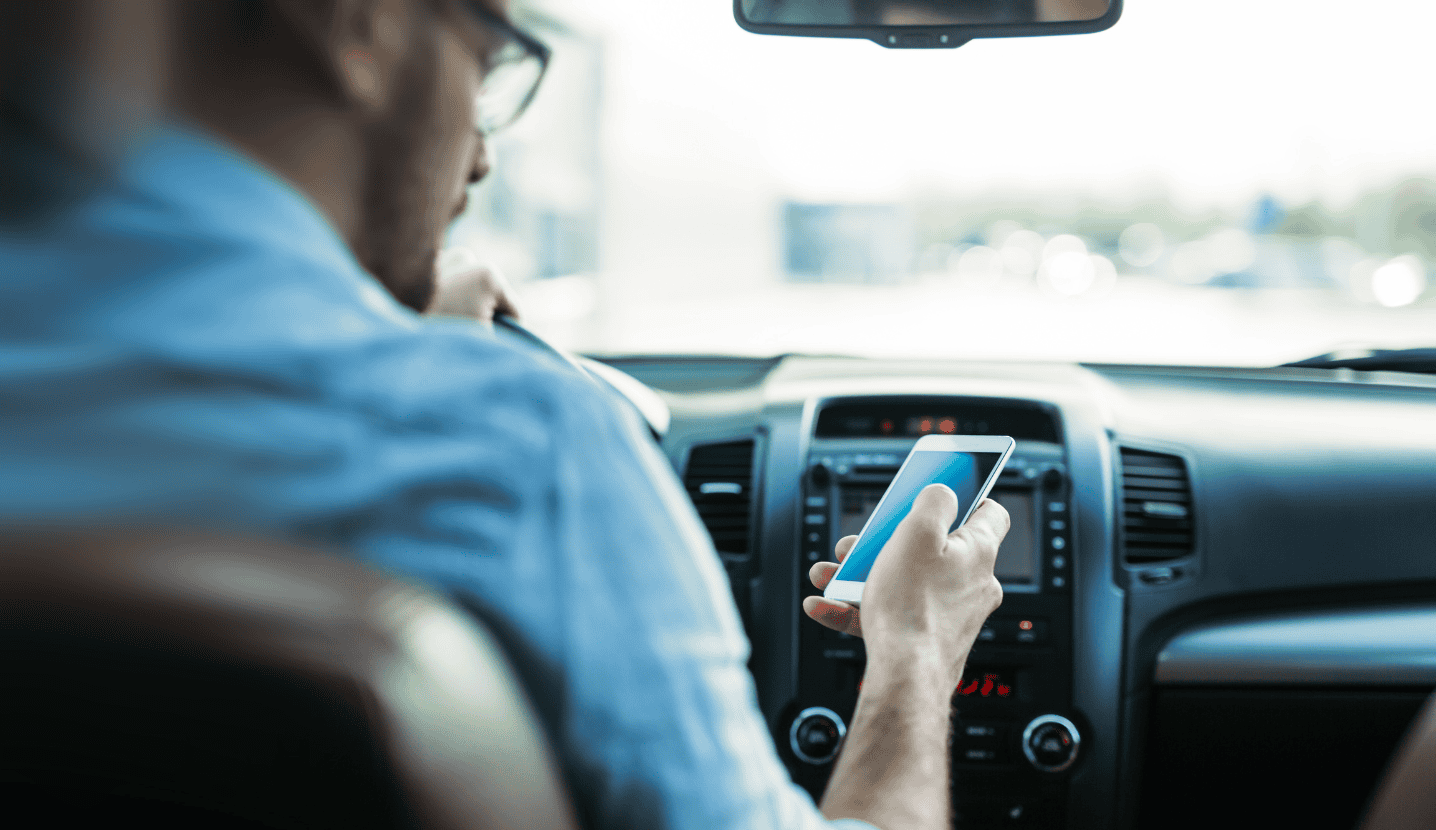
It’s a sight that has become all too common on Missouri roads: a car ahead suddenly swerves, drifts out of its lane or changes speeds erratically. The likely culprit? A distracted driver looking at their cell phone.
For years, this behavior was a source of frustration and danger, but now, it is explicitly illegal in Missouri. The Siddens Bening Hands Free Law officially went into effect on January 1, 2025. This “phone down law” makes it illegal for drivers to hold or use their phones while driving. This includes texting, checking social media, streaming video or holding the phone for a call.
This new law has major implications for personal injury cases. If you are injured in a car collision, how does a car accident lawyer prove the at fault driver was distracted? While the law helps, the key to your case is often in the data.
For this reason, experienced car collision attorneys use cell phone records as critical evidence to prove liability and build the strongest possible case on your behalf.
An Admission Isn’t Enough: The Need for Hard Evidence
In the chaotic moments after a collision, a driver might admit to the police or to you that they were “on the phone” or “just dropped something.” This is a helpful start, but it is not the end of the story.
Why isn’t an admission enough? People’s stories can change. Once an insurance company gets involved, that casual admission at the scene can quickly become, “I only glanced at my phone after the collision,” or “I wasn’t using it at all.”
A statement made to a police officer is not the same as sworn testimony and can be contested. This is why your legal team also relies on objective, digital evidence that is not subject to interpretation or a faulty memory. These records provide the concrete proof needed for an auto injury attorney to paint a clear picture of the driver’s actions in the moments that matter.
How Padberg Appelbaum Knepper Obtains Cell Phone Records
A common question we receive is whether we can simply check the other driver’s phone records. The answer is no. Obtaining these private records is a formal legal process that respects privacy laws while ensuring we can gather the necessary evidence.
Step 1: Filing a Lawsuit
First, we must file a lawsuit on your behalf. This step is imperative. Before a lawsuit is filed, an attorney has no legal authority to demand this kind of private information from a third-party corporation, like a cell phone provider.
Step 2: The Discovery Process
Once the suit is filed, it enters what’s called a ” discovery phase.” This is the part of the lawsuit where both sides formally exchange information and gather evidence. As part of our standard discovery process in any car collision case where cell phone use is indicated or a likely contributing factor, we will file a formal request, called a subpoena, with the at-fault driver’s cell phone carrier.
This subpoena does not give us the content of text messages or allow us to listen to their calls. Instead, it compels the provider to produce detailed logs. These logs can show the exact time, down to the second, of every:
- Phone call (incoming and outgoing)
- Text message (sent and received)
- Data usage (which indicates an app was in use)
We then compare this timeline directly against the time of the collision as listed in the official police report. If the records show a text message was sent at 3:32:15 PM and the collision was reported at 3:32:18 PM, we have found the critical link to prove negligence.
Using Records to Prove Liability (Not Increase Damages)
This is an important concept to understand. Proving that the other driver was using their phone in a cell phone car accident does not automatically increase the dollar amount of the damages.
Damages are calculated based on your medical bills, lost wages, future medical needs, and pain and suffering. A jury cannot add extra money just because the other driver was reckless.
So, why do we work so hard to get these records if the damages do not increase? Because these records can assist in proving liability. The records decisively strengthen your case by demonstrating a clear, undeniable breach of the driver’s duty to operate their vehicle safely.
In Missouri, especially with the “phone down law,” this evidence shows the at-fault driver wasn’t just momentarily careless. They were actively breaking the law at the time of the collision. This makes it incredibly difficult for their insurance company to argue that you were partially at fault or that the collision was unavoidable.
It helps your lawyer shut down defense arguments and focus on what truly matters: getting you the fair judgment and compensation you deserve.
Your Priorities After a Car Collision
If you are involved in a collision, your world can be turned upside down in an instant. In the confusion and shock, it can be hard to know what to do.
Your first and most important priority is your health. Seek medical attention immediately, even if you are feeling even remotely off. Adrenaline can mask serious injuries. Go to the emergency room or see your primary care physician as soon as possible. Getting the appropriate medical care you need is the only thing that matters in those first few hours.
Once you are safe and your medical needs are being addressed, your next step should be to contact an experienced personal injury attorney. It is crucial to have someone on your side from the very beginning, protecting your rights and preserving evidence while you focus on healing.
We Are Here to Help
Being injured in a car collision caused by a distracted driver is a frustrating and overwhelming experience. You are trying to heal while worrying about medical bills, lost work and an uncertain future.
At Padberg Appelbaum Knepper, we understand this. We are here for you when the worst happens.